

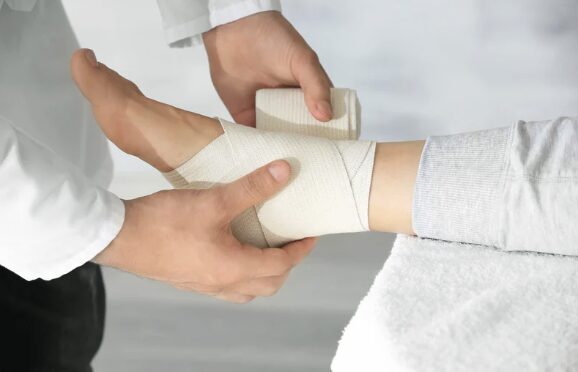

Sprain is a word bandied about a lot, but many people don’t really know what it means. Is it a bruised joint? A bruised muscle? A torn muscle? What condition is it really? We’re talking about joints, here.
A Little Anatomy
A joint is where two bones meet. Most joints are mobile; some are not (like in the skull). Joints are kept in place by ligaments, which bind bone to bone, and also by the muscles around the joint. Muscles attach to bone through tendons. Ligaments and tendons are known as “soft” tissues, as opposed to bone, which is “hard” tissue. Between and around the joints are other soft tissues like cartilage or menisci and fluid sacs for joint lubrication..
What is a Sprain?
A sprain is a tear of the ligaments or tendons. It can be small, moderate, or severe. The worst-case situation is a complete rupture of the ligament, whereby the joint will lose stability. Common examples are twisting injuries of the ankle causing ankle sprains, knee sprains from skiing, and shoulder sprains from multiple sports and activities. When the ligament or cartilage tears, there is pain and a sensation of not being able to rely upon or trust that joint. Bleeding occurs, so there will be swelling (”edema”) and bruising. The areas will be tender to the touch. Sometimes there may be an associated fracture of the adjacent bone if severe enough.
How Do You Diagnose a Sprain?
Quite often, the clinical findings are sufficient. An X-ray will not help as it does not detail soft tissues, though it may show an adjacent fracture. If you need confirmation or are in doubt, then an MRI is your best option to get the diagnosis. 3-Tesla MRIs are preferable over 1.5 Tesla ones in terms of getting better detail. If you are claustrophobic, then you may be stuck with an open MRI, which is typically only 1.5T. CTs are not as good as an MRI for this.
What is the Treatment and for How Long?
There’s an old acronym in emergency medicine for this: RICE. This stands for Rest, Ice, Compression, and Elevation. In order, don’t overuse the affected joint and let it rest for several days, in cases a week or more. Ice, or cold therapy, reduces both swelling and pain. Apply cold packs (frozen pea bags work just as well!) for twenty minutes every two to four hours while awake for the first two days after an injury. Cold therapy helps a lot with the pain, but you should know there is no evidence that it has long-term benefits. You can start adding a little heat therapy on the third day. Compression usually represents snugly binding the joint with an elastic rollable bandage or a brace; either way, you are immobilizing it for the first few days to a week to give the healing process a good start. Elevation above the level of your heart helps bring the swelling down through the force of gravity. Prolonged swelling will prolong healing, so it is a good idea to get rid of the edema as quickly as you can. If the sprain is in the leg, you may need crutches to keep the weight off the joint so that it has the best chance to begin healing, but you never want to prolong the immobilization for more than a week or so because the joint can get stiff and, in worst-case scenarios, “freeze”. Movement, also called mobilization, after a week is necessary for regaining range of motion and speeding up healing. For pain you can take acetaminophen (Tylenol) or a non-steroidal anti-inflammatory drug (“NSAID”) such as ibuprofen (Advil and Motrin are the same thing as this) or naproxen. If you take ibuprofen, 400mg in an adult is sufficient; 600mg may be called for in very severe cases. Please don’t take 800mg tablets as they are no more effective than the lower doses and run the risk of causing an ulcer or kidney damage. The sooner you can get off a medication, the better.
Summary
If you experience a sprain emergency, knowing what to do immediately can make all the difference. Sprain can be debilitating. They don’t always require a visit to the Emergency Room. If in doubt, contact us at The Village Doctor, and we can guide you through the injury. Healing may take up to six weeks. Imaging can help with the diagnosis. With bad sprains, you should follow up with an orthopedist. We are always here for you.
Wishing you health and fitness,
Alan Spira, MD, & DTM&H, October 2025
Read Also: Get Your Teenager (and Yourself) to Bed!
Take the first step towards improving your child’s health with pediatric integrative medicine. Call The Village Doctor at (650) 851-4747 or Contact us to learn more about the practice.