
In an emergency, minutes matter.
Home Defibrillators are simple devices that can save a life when the heart stops working. Sudden cardiac arrest is one of the leading causes of death worldwide. It often strikes without warning—at home, during sleep, or while doing ordinary daily activities. It can be due to a heart attack, which is caused by blocked blood flow which can lead to an abnormal or erratic electrical heart conduction; cardiac arrest occurs when the heart suddenly stops beating effectively. When this happens, time is not on your side.
This is where home defibrillators come in.
How Do Home Defibrillators Work?
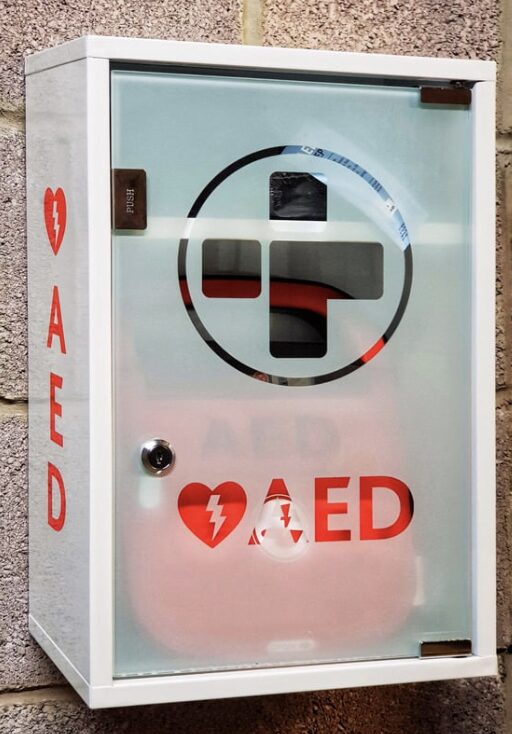
A home defibrillator—more accurately called an Automated External Defibrillator (AED)—is a lightweight, portable device designed to restart the heart during certain life-threatening rhythm disturbances. Once found mainly in hospitals and ambulances, AEDs are now common in airports, schools, gyms, and increasingly, private homes.
Having one nearby can mean the difference between life and death.
In sudden cardiac arrest, the heart usually goes into a chaotic rhythm such as ventricular fibrillation. Instead of pumping blood, the heart muscle quivers. Within seconds, the person collapses and becomes unresponsive. Without treatment, irreversible brain damage can begin in as little as four minutes.
Calling 911 is essential—but emergency response takes time. Paramedics will use an AED or a more advanced version, but the clock is against you if there is traffic, long distances for the ambulance to travel, or other emergency calls before yours–all strikes against you. It is truly a race against time. Even in well-staffed communities, it may take 8–12 minutes or longer for paramedics to arrive. By that point, survival chances drop dramatically unless early CPR and defibrillation have already begun.
This is why a home AED can make the difference between life and death.
A defibrillator delivers a controlled electrical shock that is meant to stop the chaotic rhythm, allowing the heart’s natural pacemaker to re-establish an effective beat.
A home AED is a compact, lightweight device—usually about the size of a small briefcase. It is user-friendly, designed for the average citizen, not the medical professional. It includes:
- Adhesive pads. You need to place two on the chest
- A battery power source
- A computer that analyzes heart rhythm
- A speaker with clear voice instructions guiding you step by step
Once turned on, the device talks you through every step: when to apply pads, when to stand clear, and whether a shock is needed. If the heart rhythm does not require defibrillation, the AED will not deliver a shock—making it extremely safe.
You cannot accidentally shock someone who does not need it.
Who Should Consider Home Defibrillators for Their Home?
When should you consider getting a home defibrillator? While anyone can benefit from access to an AED, home ownership is especially worth considering for households that include:
- Someone with known heart disease
- A history of heart attack or heart failure
- Prior cardiac arrest
- Inherited rhythm disorders
- Adults over age 50
- Homes far from emergency services
- Families with high physical activity or athletic training
Many cardiac arrests occur at home, often witnessed by a spouse or family member. In those situations, having an AED immediately available can dramatically improve survival. Studies consistently show that early defibrillation—within the first three to five minutes—can raise survival rates to 50–70%, compared with under 10% when defibrillation is delayed.
Home defibrillators are incredibly easy to use. Modern AEDs are intentionally designed to be simple, calm, and reassuring. Most include spoken instructions in plain English; visual diagrams on the pads; automatic rhythm detection, and safety systems preventing misuse. Some models even provide CPR coaching, including prompts for compression depth and rate.
An AED does not replace CPR. Everyone should take a CPR class. It can make the difference between survival and not. But really, training is not mandatory. People have successfully used an AED for the first time in a real emergency, guided entirely by the device’s voice prompts. However, knowing about compressions and breathing is very important, and a short CPR class will teach you what you need to know.
How Much Do Home Defibrillators Cost?
Home AEDs typically cost between $1,200 and $2,000, depending on features. While this is a significant expense, many families view it the same way they view fire extinguishers or home security systems: something you hope never to use, but are grateful to have.
There is minimal maintenance needed, with batteries lasting several years, pads needing replacement every two to four years, and devices performing automatic self-checks.
Some health savings accounts (HSAs) and flexible spending accounts (FSAs) allow AED purchases, and certain insurers may reimburse in high-risk cases.
Here is your Barney-style checklist for someone collapsing and is unresponsive:
- Call 911 immediately
- Begin CPR if trained
- Apply the AED as soon as it is available, turn it on, and follow the prompts.
CPR keeps oxygen flowing to the brain; the AED treats the underlying heart rhythm. Together, they form the most effective lifesaving response possible outside a hospital.
The best argument for an AED is that the greatest value of a home defibrillator is psychological. For families living with heart disease, the fear of “what if something happens” can be constant. Knowing there is a proven, lifesaving device within arm’s reach provides reassurance—not only to patients, but to spouses and loved ones as well. Many survivors of cardiac arrest are alive today not because they were near a hospital, but because someone nearby had access to an AED and acted quickly.
In an emergency, minutes count. Time is against you. Sudden cardiac arrest is unpredictable, fast, and often fatal without immediate action. Emergency medical systems are excellent—but they cannot arrive instantly. A home defibrillator places lifesaving power where it is often needed most: inside the home. While not every household requires one, for many families—especially those with cardiac risk—it can be a wise, responsible, and potentially life-saving investment.
We, at The Village Doctor, are happy to guide you through the decision-making process of whether to choose a home defibrillator or not. It is part of our concierge service.
Wishing you the best of health,
Dr. Spira
Alan Spira, MD, & DTM&H, March 2026
Read Also: Get Your Teenager (and Yourself) to Bed!
Take the first step towards improving your child’s health with pediatric integrative medicine. Call The Village Doctor at (650) 851-4747 or Contact us to learn more about the practice.