

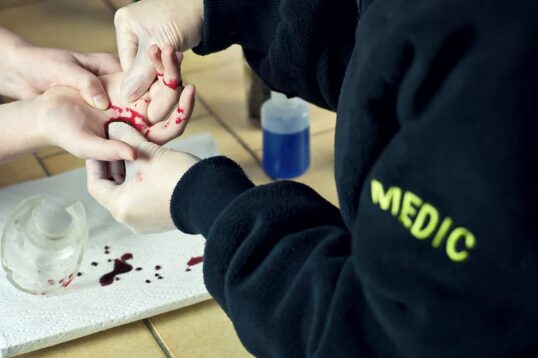

I’m bleeding! What do I do?
Few things are scarier than bleeding. The sight of blood sends some people into panic, and others faint. Realistically, most bleeding is worse than it looks. Your body holds about 5 liters (about 10 pints), and with severe blood loss, you can go into shock, but most bleeding is realistically mild and not likely to send you into any life-threatening condition. It is the lesser bleeds that we are going to mostly talk about today.
Types of Bleeding
Bleeding tends to be one of two types: from veins, which have low pressure, or from arteries, which have high pressure. You can also bleed from capillaries, but we won’t worry about that today. Most bleeding is going to be venous, as they are closer to the surface, whereas arteries tend to be buried deeper within you. Arterial bleeding is the scariest form of bleeding, as the blood can shoot out from the high pressure it is under. Arterial blood is blood coming out of the heart (and is full of oxygen), and venous blood is blood coming back to the heart after passing through the capillaries (depleted of blood).
Causes of Bleeding
Let’s talk about the most common or concerning types of bleeding. We will exclude internal bleeding and only discuss visible, external bleeding.
Trauma is the one we are most concerned about, typically, from lacerations, which are cuts or gashes. This is the type most likely to cause a large blood loss. Venous bleeding tends to be dark, bluish, or purplish and flows at a steady pace. If you are unlucky enough to hit an artery, then the blood is going to be bright red and may shoot out in squirts concurrent with your pulses. Trauma from cuts, punctures, and bites will bleed outward. Bleeding that is contained under the skin is a bruise, also known as a “hematoma,” and is more likely due to blunt trauma rather than penetrating injuries.
Nosebleeds can be from dry air, nose-picking, being on blood thinners, or blunt trauma. 90% of nosebleeds are in the front of the nose (“anterior nosebleed”), the remainder being deeper in the nose (“posterior nosebleed”). Anterior nosebleeds are much easier to stop than posterior nosebleeds.
Hemorrhoids are just dilated veins around your anus. They can be on the inside (internal hemorrhoids) or external (external hemorrhoids). Internal hemorrhoids are more likely to bleed, while external hemorrhoids tend to cause pain, though they certainly can bleed.
Kidney stones are just that – stones. They can be tiny, like gravel, or large. As they pass from the kidney down the urinary tract to the bladder and then out of your body, the stone rubs against the genitourinary tract walls, which then bleed. Seeing blood in your urine can be alarming but doesn’t necessarily indicate a serious condition, through on occasion, genitourinary cancers can cause blood in the urine–but this is much less common.
Menstrual periods are a well-known cause of bleeding in women and a cause of anemia, but they won’t be addressed here in this issue.
What you can do
With trauma, the most important first step is to apply pressure to the bleeding site. If you have gauze, lay it over the bleeding site and compress firmly for five to ten minutes. If the bleeding is from an extremity, raise that extremity in the air to lower the blood pressure and diminish bleeding. You can also apply pressure to a pressure point if you know where they are located. If the bleeding does not stop after several minutes of consistent, firm pressure, then you should seek help at an urgent care or emergency department. If the bleeding is arterial–shooting blood or gushing extensively, it may be wise to call 911 to get professional help to stop the bleeding, as there are several tools available to paramedics and physicians above and beyond the basics of first aid. These include blood-clotting medication, artificial clot sponges, tourniquets, surgical procedures, and even transfusions in the worst-case scenarios. Mild bleeding, once stopped, should be dressed with a bandaid, a gauze or coban dressing, or even over-the-counter medical skin glue.
Nosebleeds can often be controlled with simple compression of the fleshy part of the nose–not over the bony part. Blow your nose, then apply firm, constant pressure for a full ten minutes. If the bleeding does not stop, or if there is blood flowing down the back of the throat, or if you are on blood thinners, then make your way to your nearest emergency department, while continuing to hold pressure.
Hemorrhoid bleeding may not respond to pressure if it is due to an internal hemorrhoid. If a hemorrhoidal suppository does not work, then you may need help from an emergency department, a gastroenterologist, or a surgeon.
Urinary bleeding may often be intermittent. Hydrate with adequate amounts of water and expect the bleeding to stop. You should follow up in the emergency room or with a urologist to ascertain the severity of the stones or if there may be a neoplasm.
Summary
Most bleeding isn’t serious. You can usually tell if the blood is from a vein or an artery; the latter is more serious and demands immediate attention. Have a good first aid kit, and fill it with the basics for controlling bleeding: gauze sponges, rollable gauze bandages, Coban wrap, Band-Aids, and medical skin glue. Follow up in the emergency room if the bleeding doesn’t stop, and make sure that your tetanus status is made current. Feel free to come into The Village Doctor to get some advice about your first aid kit and tips on minor emergencies, such as bleeding.
Wishing you health and safety,
Alan Spira, MD, & DTM&H, September 2025
Read Also: Get Your Teenager (and Yourself) to Bed!
Take the first step towards improving your child’s health with pediatric integrative medicine. Call The Village Doctor at (650) 851-4747 or Contact us to learn more about the practice.