Why Bone Health Is About More Than Bones
Bone loss is a critical public health concern due to the high morbidity and mortality associated with osteoporotic fractures, particularly hip fractures. Hip fractures are a leading cause of death and disability in older adults, with 1-year mortality rates ranging from approximately 16% to 30% in most populations, and up to 28.3% in the United Kingdom. Among those over 80 years old or with significant comorbidities, 1-year mortality can approach or exceed 30%. [1][3-4]
Falls are the leading cause of unintentional injury death in adults aged 65 and older. In the United States, 27.6% of older adults report falling each year, and in 2021, nearly 39,000 older adults died as a result of unintentional falls. More than 95% of hip fractures in the elderly are caused by falls. [5][7]
Functional outcomes after hip fracture are poor: only about half of survivors regain their pre-fracture ability to walk independently, and many never return to their previous level of independence. Hip fractures are associated with a persistent increase in mortality risk for up to a decade after the event. [8-12]
These data underscore the importance of bone health and fall prevention in reducing fracture risk, morbidity, and mortality in older adults.[1-2][5-6]
The good news is there is a low-to-no side-effect way to not only prevent bone loss, but rebuild bone.
Rethinking Bone Health
Counter to what I was taught in medical school, it is possible to prevent and even reverse bone loss. And it takes far more than calcium supplements and a daily walk. In fact, my entire understanding of bone health was turned upside down when I experienced my own significant bone loss – nearly 10% of my hip bone density and 6% of my spinal bone mass in just two years. I knew I had to act—fast. And what I learned from working with my skilled coach, mentor and multiple time world weight lifting champion, Jerzy Gregorek, and researching the topic further changed the way I not only care for myself, but the way I practice medicine.
What Is Osteopenia? Osteoporosis? What Does a DEXA Scan Measure?
If you’ve ever looked at a DEXA scan report, you’ll notice terms like “T-score” and “BMD.” Here’s a quick breakdown:
- A DEXA scan measures bone mineral density (BMD) using low-dose X-ray technology.
- Bone Mineral Density (BMD) is reported in grams per square centimeter (g/cm²).
- The T-score compares your bone density to that of a healthy 30-year-old of the same sex.
- A T-score of -1.0 or higher is normal.
- A T-score between -1.0 and -2.5 indicates osteopenia (low bone density, but not osteoporosis).
- A T-score of -2.5 or lower is diagnostic for osteoporosis.
My Personal DEXA Results: A Real-World Case of Rebuilding Bone
These are actual results from my own journey over three years:
From November 2022 to February 2024 (before structured training):
- Left Hip: Lost 8.5% of bone density
- Right Hip: Lost 10.1% of bone density
- Spine (L1–L4): Lost 4.4% of bone density
From February 2024 to February 2025 (after consistent strength training):
- Left Hip: Gained 1.2% bone density
- Right Hip: Gained 1.3% bone density
- Spine: Lost 0.6% (an improvement from 4.4% loss over the prior few years)
That means I reversed the rate of loss in my hip by 11% —and I did it without medications, simply through progressive strength training with a skilled trainer.
When I first started, I was lifting 0 pounds. The following week, I started using 2-pound dumbbells. I never thought I’d be squatting 200 pounds or deadlifting 170 pounds as I am now. The most exciting part is that now, I’m no longer starting from zero. With continued training, I expect future scans to show even greater gains.
Why Most Exercise Isn’t Enough to Rebuild Bone
While aerobic activities like walking, swimming, and yoga have many benefits, they don’t provide the mechanical load necessary to stimulate bone growth. Bone responds to force, and that force needs to come from impact or heavy resistance.
Here’s what helps build or maintain bone:
- Swimming and yoga: Not weight-bearing, helpful for balance and flexibility
- Walking and jogging: Low to moderate load on bones, helpful for maintenance
- Bodyweight exercises: Better, but limited for reversing bone loss
- Progressive resistance training: High-impact stimulus for bones—especially with lifts like squats and deadlifts
The most effective strategy is short, heavy lifts with proper form, rest between sets, and slow progression. This sends a signal to your bones that they need to get stronger to support the load.
Obese individuals, for example, rarely develop osteoporosis because their bones are chronically loaded – the bone has the signal that it must continue to grow or it will break under the weight. However, because they don’t ever have breaks from carrying their body weight, they develop complications such as arthritis of the knee joints. For the same reason, petite women, especially postmenopausal women, are at higher risk for bone thinning; the bone assumes it would be wasting energy growing more. Progressive heavy weight lifting allows us to temporarily simulate that mechanical “positive” stress.
The Science: What the LIFTMOR Study Taught Us
The LIFTMOR study followed postmenopausal women with osteoporosis as they performed supervised, high-intensity resistance training for 8 months. Key results included:
- Lumbar spine density increased significantly: participants went from bone mineral density (BMD) -1.2 in their spine to +2.9 with heavy weight lifting in an even shorter time period of 8 months
- Femoral neck (hip) BMD improved significantly: participants’ femoral neck bone mineral density (BMD) went from -1.2 in the control group to +.3 in the treatment group in 8 months
- No increase in fractures or serious injuries
In other words, supervised heavy lifting helped these women regain bone, not just slow loss.
The Weighted Quarter Squat and Deadlift: High Impact, Low Risk
One of the most powerful tools in this process is the weighted quarter squat:
- The “quarter” range of motion means you’re only bending the knees very slightly – not doing a full-depth squat or dead-lift —reducing strain on the back, hips, and knees.
- The movement still loads the spine and hips, sending a signal to bones to remodel and strengthen.
- Short, heavy efforts with rest between sets allow you to simulate the skeletal loading of obesity—without harming the joints.
A Common Fear: Is Heavy Lifting Safe for People with Bone Loss?
Even many experienced trainers hesitate to work with clients who have osteopenia or osteoporosis, fearing that lifting heavy weights could cause fractures. But studies like the LIFTMOR trial, which looked at osteoporotic patients, have shown that heavy lifting, when done with supervision and proper form, is not only safe in this population—it can significantly improve bone mineral density. What matters is:
- If you have no fracture history, you can safely start with light resistance and progress gradually – ideally with supervision from a skilled trainer.
- If you have had a prior fracture (such as a wrist or vertebral fracture), your trainer should adjust your plan—perhaps beginning with weighted squats rather than deadlifts, or modifying the lift to reduce risk.
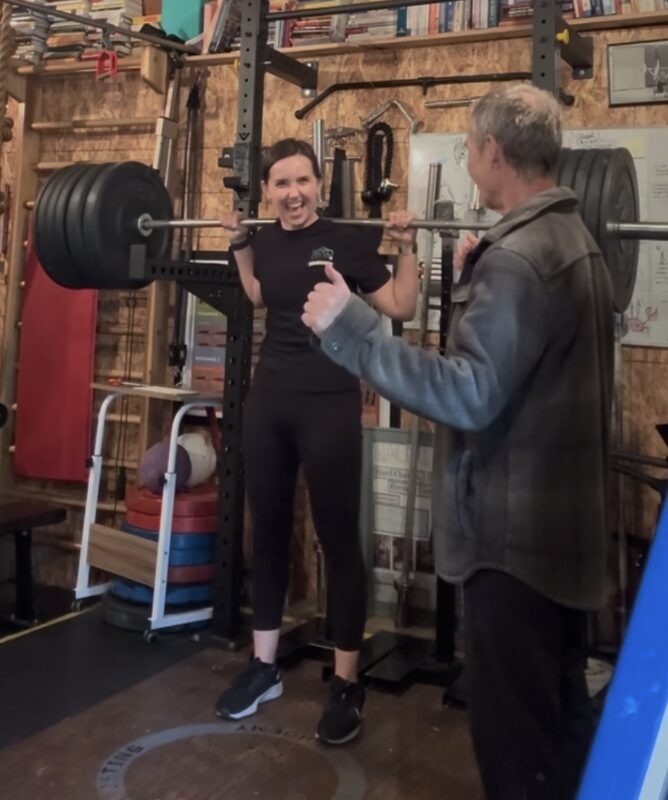
If you told me 18 months ago that I’d be doing weighted quarter squats with 200 lbs, I would have laughed. But by starting low, moving slow, and staying consistent with 16-20 minutes minimum daily, I not only gained strength—I rebuilt bone.
Who Should Get Screened Early?
Insurance generally covers DEXA screening at age 65, but many people develop low bone mass long before that. Some conditions affect bone through inflammation, steroid use, or altered calcium/vitamin D metabolism. You should consider talking to your doctor about early screening if you:
- Are postmenopausal, especially if you are low-normal weight or underweight
- Are bed-bound or very sedentary
- Have a family history of osteoporosis or hip fractures
- Use or have used corticosteroids (e.g., prednisone)
- Have a history of autoimmune disease (e.g., Rheumatoid arthritis, Lupus, Inflammatory bowel disease such as Crohn’s or Ulcerative Colitis, Celiac Disease, Psoriatic Arthritis, Type 1 Diabetes, and Autoimmune thyroid disease, especially)
- Have any condition causing malabsorption (e.g., bariatric surgery, chronic pancreatitis, celiac disease, severe lactose intolerance, if leading to inadequate calcium, etc.)
- Are of Southeast Asian ethnicity
An Evidence-Based Program: The Onero Approach
The Onero program, developed by Dr. Belinda Beck (the researcher behind the LIFTMOR study), is one of the most effective bone-specific exercise regimens available. It includes:
- Deadlifts
- Squats
- Overhead presses
- Progressive resistance training
- Fall-prevention and balance training
I’ve researched and vetted local providers certified in this method who can help patients start safely and progress gradually.
You can also hear Dr. Beck explain the science on Peter Attia’s podcast here.
Final Thoughts
Bone health is personal for me—not just professionally, but in my own body. I’ve seen what happens when we neglect it. I’ve also seen what’s possible when we prioritize it.
Bone loss is not just preventable – it is reversible.
Whether you’re 34 or 74, it’s not too early—or too late—to start building a stronger foundation.
I have no conflicts of interest to disclose. All information shared is for purposes of sharing education and knowledge.
If you have feedback on this article or on future topics you’d like Dr. Maia Mossé to write about, or are interested in working with Dr. Mossé, feel free to message the team at info@villagedoctor.com or via Instagram at @villagedoctor.
Read Also: Unlocking Longevity and Vitality: The Power of Exercise
Maia Mossé, MD, August, 2025
- Global Epidemiology of Hip Fractures: Secular Trends in Incidence Rate, Post-Fracture Treatment, and All-Cause Mortality. Sing CW, Lin TC, Bartholomew S, et al. Journal of Bone and Mineral Research : The Official Journal of the American Society for Bone and Mineral Research. 2023;38(8):1064-1075. doi:10.1002/jbmr.4821.
- Hip Fractures: Diagnosis and Management. Schroeder JD, Turner SP, Buck E. American Family Physician. 2022;106(6):675-683.
- One-Year Mortality After Hip Fracture Surgery and Prognostic Factors: A Prospective Cohort Study. Morri M, Ambrosi E, Chiari P, et al. Scientific Reports. 2019;9(1):18718. doi:10.1038/s41598-019-55196-6.
- Risk Factors and Mortality of Patients Undergoing Hip Fracture Surgery: A One-Year Follow-Up Study. Huette P, Abou-Arab O, Djebara AE, et al. Scientific Reports. 2020;10(1):9607. doi:10.1038/s41598-020-66614-5.
- Nonfatal and Fatal Falls Among Adults Aged ≥65 Years – United States, 2020-2021. Kakara R, Bergen G, Burns E, Stevens M. MMWR. Morbidity and Mortality Weekly Report. 2023;72(35):938-943. doi:10.15585/mmwr.mm7235a1.
- Interventions to Prevent Falls in Older Adults: Updated Evidence Report and Systematic Review for the US Preventive Services Task Force. Guirguis-Blake JM, Perdue LA, Coppola EL, Bean SI. JAMA. 2024;332(1):58-69. doi:10.1001/jama.2024.4166.
- Prevention of Fall-Related Injuries in the Elderly: An Eastern Association for the Surgery of Trauma Practice Management Guideline. Crandall M, Duncan T, Mallat A, et al. The Journal of Trauma and Acute Care Surgery. 2016;81(1):196-206. doi:10.1097/TA.0000000000001025.
- Hip Fracture Management: Tailoring Care for the Older Patient. Hung WW, Egol KA, Zuckerman JD, Siu AL. JAMA. 2012;307(20):2185-94. doi:10.1001/jama.2012.4842.
- Determinants of Lack of Recovery From Dependency and Walking Ability Six Months After Hip Fracture in a Population of People Aged 65 Years and Over. González Marcos E, González García E, González-Santos J, et al. Journal of Clinical Medicine. 2022;11(15):4467. doi:10.3390/jcm11154467.
- Twelve Month Mortality Rates and Independent Living in People Aged 65 Years or Older After Isolated Hip Fracture: A Prospective Registry-Based Study. Giummarra MJ, Ekegren CL, Gong J, et al. Injury. 2020;51(2):420-428. doi:10.1016/j.injury.2019.11.034.
- Hip Fracture, Mortality Risk, and Cause of Death Over Two Decades. von Friesendorff M, McGuigan FE, Wizert A, et al. Osteoporosis International : A Journal Established as Result of Cooperation Between the European Foundation for Osteoporosis and the National Osteoporosis Foundation of the USA. 2016;27(10):2945-53. doi:10.1007/s00198-016-3616-5.
- Excess Mortality After Hip Fracture in Elderly Persons From Europe and the USA: The CHANCES Project. Katsoulis M, Benetou V, Karapetyan T, et al. Journal of Internal Medicine. 2017;281(3):300-310. doi:10.1111/joim.12586.
Featured Image Me carrying 200lbs for the first time with my trainer,
Jerzy Gregorek (4-time world weight-lifting champion), cheering me on.
Call The Village Doctor at (650) 851-4747 or Contact us to learn more about the practice.